I like thermally broken aluminium windows. I spent years selling the strips that go in them. A good break is one of the best things you can put in an aluminium frame. So it bothers me how often the break is doing its job perfectly while the window, as installed, still runs cold.
A thermally broken window has its aluminium frame split into an inside half and an outside half, joined by a low-conductivity material: a polyamide strip, or a poured-and-debridged resin. The idea is simple. No single piece of metal touches both room air and outside air, so heat can’t run straight through the frame. That single piece of metal is what we call a thermal bridge, and the break exists to cut it.
Tested on its own, that is exactly what happens. The trouble starts on site.
Three ways we undo a thermal break
1. Metal across the break
A screw through both halves of the frame. A sub-sill fixed through the break. A continuous aluminium locking bar. A slider where only the outer frame is broken and the sash or second track stays solid. Each one is a small metal bridge straight across the strip you paid for. In the thermal break that isn’t, we modelled one thermally broken sliding door with its sill under both doors. The frame U-values were almost identical (5.80 vs 5.75 W/m²K), but the unbroken side ran about 3 °C colder and reached mould risk once the room passed 41 % humidity, against 50 % for the broken side. Same window, same label.
2. The frame out at the cladding, over a ventilated cavity
Australian walls drain and dry through a ventilated cavity behind the cladding, and that cavity sits at outside-air temperature. Push the window out to the cladding line and the room-side metal of the frame ends up bare to that cavity. In Episode 3, the same thermally broken window had a coldest room-side surface of 13.1 °C tested on its own and 10.2 °C installed, into the mould-risk band. The installed metal route read R 0.159 m²K/W: exactly the figure for a window with no break at all. The break wasn’t weakened. It was walked around.
3. The reveal gap left empty
The gap between the window reveal and the stud is where the frame meets the wall. In our window-to-wall study we modelled 40 sill details hour by hour over a full year and scored them on the AIRAH DA07 Mould Index (below 3 passes). Thermally broken frames still scored 4.28 to 4.55 in climate zone 5, and the tape and gap fill swung the installation gap from one of the best results in the study to one of the worst. An empty gap behind a closed-cell tape was the worst detail we ran. The break can’t fix a junction it isn’t part of.
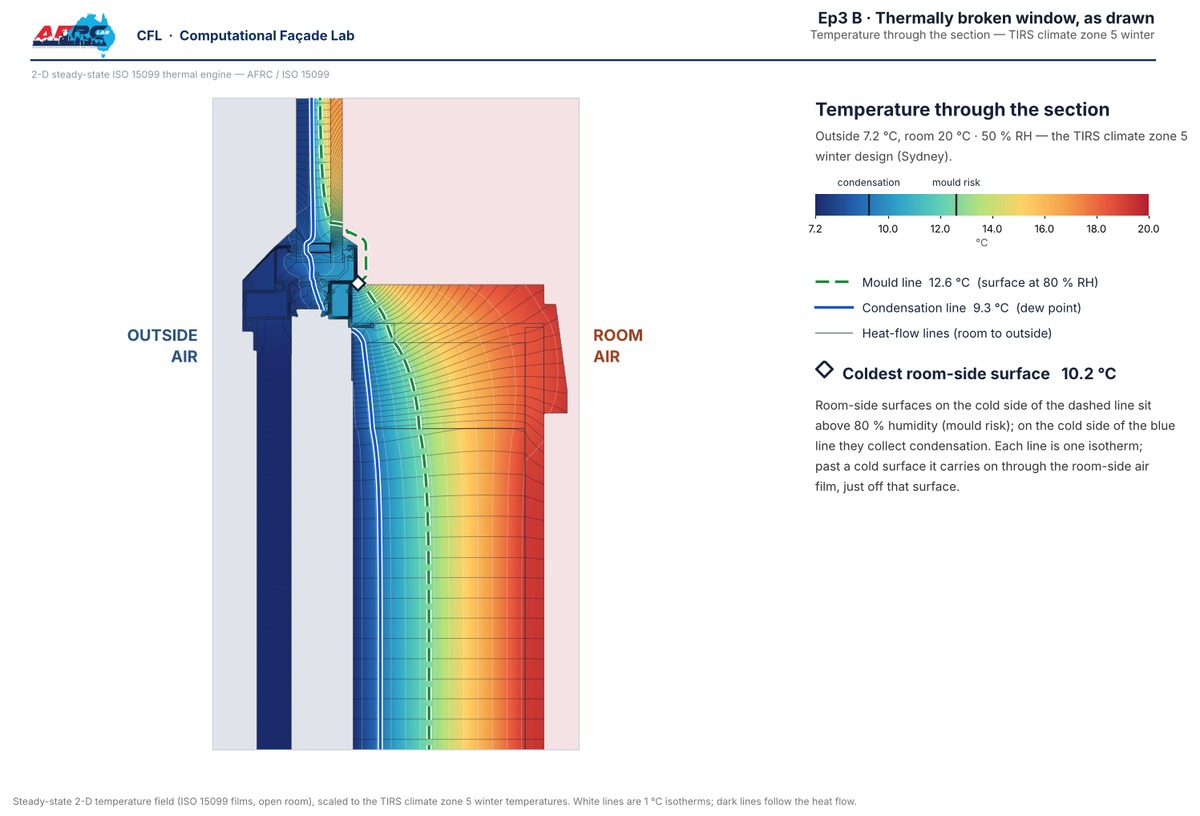
The window did its job. The installation didn’t let it.
Why the rating never sees it
A window’s rating is the window tested alone, at a standard size, with no wall around it. That is fair for comparing products, and it is how WERS listings work. But none of the three problems above exist until the window is in a wall. The frame’s cold line is then averaged into a whole-window U-value, and the NCC’s thermal bridging rules count the steel studs but not the aluminium frame around every opening (the thermal bridge nobody counts). So a thermally broken window can carry a good number on paper and a mould line on site, and nothing in the paperwork connects the two. The window you specify isn’t the one installed.
That matters more now. NCC Part F8 condensation management and its verification method (F8V1) score mould risk with the AIRAH DA07 Mould Index, and the ABCB’s own Condensation in Buildings handbook treats junctions as part of the problem. Mould at the window is now a design question, not just a cleaning one (condensation is now a compliance failure).
Are thermally broken aluminium windows worth it in Australia?
Yes. In every comparison we have run, the broken frame runs warmer than the same frame with no break: in Episode 3, 10.2 °C installed against 8.3 °C, which is below the dew point. What you are paying for is a potential. Whether you get it depends on where the break ends up and what crosses it. Buy the break, then protect it.
It is also why I wouldn’t trade frame for glass. Across the 756 frame sections in the AFRC Frame Index, the typical Australian frame loses heat at about 6.5 W/m²K, roughly 2.4 times the double glazing beside it. Better glass in a cold frame still leaves the coldest line at the frame.
What to ask for on your next job
- Break in line with the insulation. The thermal break should sit in the warm plane of the wall, not out at the cladding over the cavity.
- Nothing metal across the break. Check fixings, sub-sill fixings, locking bars and slider sashes or tracks that stay unbroken.
- The reveal gap filled and taped. Vapour-open tape with the gap filled by pre-compressed foam tape was the best detail in every case we modelled.
- The junction modelled as installed. Ask for the frame and its wall junction modelled to ISO 15099, with the coldest surface and Mould Index reported, not the catalogue figure.

I’ve watched the industry spend real money on thermal breaks for nearly thirty years, and I’ve watched a lot of that money get installed away. The break is a promise the window makes. The installation decides whether it keeps it.
Common questions
Why do thermally broken windows still get condensation or mould?
Usually because the installation gives heat a route around the break: a metal fixing or sub-sill across it, the frame sitting over a ventilated cavity, or an empty gap between reveal and stud. In our modelling the same thermally broken window went from 13.1 °C on its own to 10.2 °C installed over a cavity, into the mould-risk band.
Are thermally broken aluminium windows worth it in Australia?
Yes. A broken frame runs warmer than the same frame without a break in every comparison we’ve modelled. But the benefit depends on where the break sits in the wall and whether anything metal crosses it, so specify the installation as carefully as the window.
Where should a thermally broken window sit in the wall?
With the thermal break in line with the wall insulation (the warm plane), not pushed out to the cladding where the room-side metal is exposed to the ventilated cavity. The cavity itself must stay ventilated; the fix is the window position and an insulated, sealed junction.
Thermal break windows vs double glazing: which matters more?
You want both, but don’t trade the frame for the glass. The typical Australian frame we’ve modelled loses heat at about 6.5 W/m²K, around 2.4 times the double glazing beside it, and condensation and mould start at the coldest line, which is usually the frame or its junction.
Does a thermally broken window pass NCC condensation requirements?
It can, but the window alone doesn’t decide it. NCC Part F8 verification scores mould risk at the junction with the AIRAH DA07 Mould Index, and in our window-to-wall study the installation tape and gap fill swung results from pass to fail. The installed detail needs to be modelled.
Is your thermal break being installed away?
Send us one window and the wall it goes into. We’ll model the frame where it actually sits, cavity, fixings and reveal gap included, and show you whether the break survives the installation.
Send us one window →Modelled results, indicative to the sections, climates and conditions described in each linked study. Steady-state 2-D analysis to ISO 15099 (AFRC Lab’s Computational Façade Lab) and full-year 2-D heat, air and moisture simulation scored on the AIRAH DA07 Mould Index. Generic illustrative sections, not a specific product, and not a compliance report. AFRC Lab (Advanced Fenestration Research & Certification) is an independent consultancy; it is not the AFRC. TIRS™ and the CFL (Computational Façade Lab) engine are of AFRC Lab Pty Ltd.