What is a thermal break window?
Heat moves the way water does — it takes the easiest path. In a standard aluminium window frame, that path is unimpeded. Aluminium conducts at around 160 W/m·K — the same continuous material from the cold outer face to the warm room side, with nothing in the way. In winter, the frame is a direct thermal highway, and the room-side surface gets cold enough to condense moisture.
A thermal break aluminium window inserts a low-conductivity material between the outer leaf and the inner leaf of the frame. The insert — typically polyamide nylon (~0.3 W/m·K) or polyurethane foam (~0.03–0.05 W/m·K) — can be anything that conducts significantly less than aluminium’s 160 W/m·K. The direct metal path is blocked. Heat trying to escape the room has to cross that insert. That is what a thermally broken window actually does to the physics: it removes the easy route.
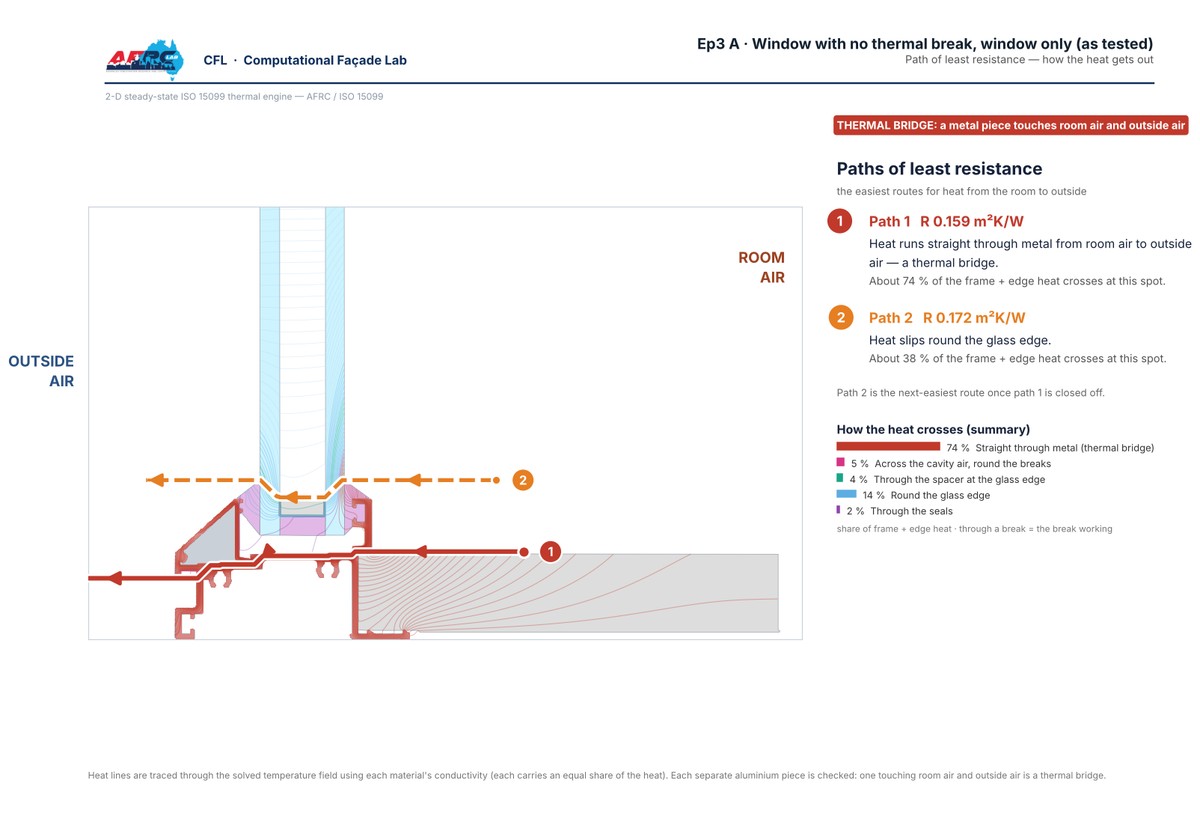
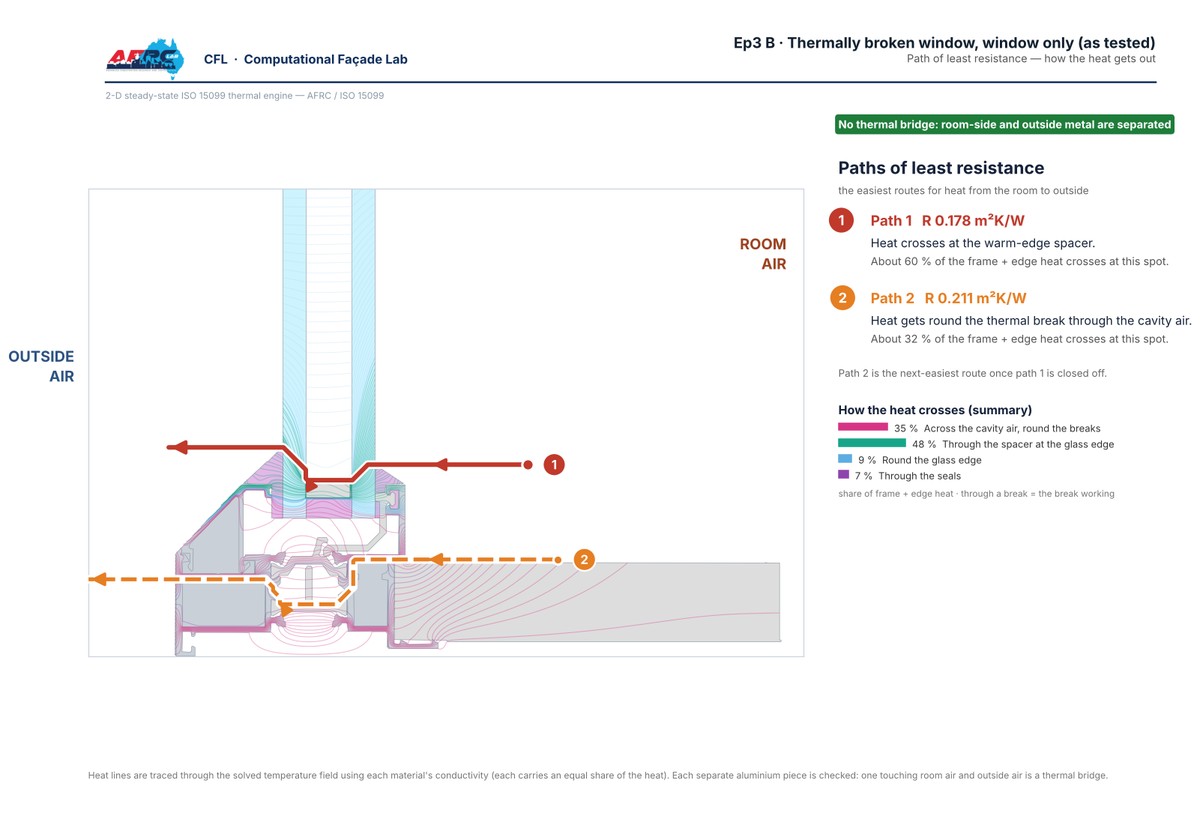
In the standard frame, Path 1 runs straight through the continuous aluminium profile — a direct thermal bridge carrying around 74% of the frame heat. In the thermally broken frame, that metal path is interrupted. Path 1 shifts: the primary route becomes the warm-edge spacer at the IGU edge. The frame is no longer the dominant path — the break worked.
What the break actually delivers
The improvement is real and consistent. When the outer leaf is separated from the inner leaf by a low-conductivity insert, the frame conductance (Uf) drops from roughly 100–160 W/m·K to around 6–10 W/m·K — a 15 to 20-fold reduction. The room-side surface warms up. The whole-window U-value (Uw) typically improves by 0.4–0.8 W/m²K for a standard double-glazed window. That matters for Section J energy modelling, for radiant comfort, and for reducing the AIRAH DA07 frame result.
That improvement is worth specifying. The break does what it says. The question is how much of it reaches the room-side surface — and that depends on something the rating doesn’t capture.
Where the break sits in the wall — installation position
NCC 2022 requires a ventilated cavity behind the cladding in most lightweight wall constructions — a gap open at the bottom and vented at the top to manage moisture in the wall. In winter, that cavity moves cold outside air. The outer leaf of a thermally broken frame — the cold side of the break — sits in that cavity.
The cavity doesn’t distinguish between thermally broken and standard frames. It strips heat from the outer leaf all day, all winter, by convection. The thermal break slows conduction through the frame profile. It has no effect on convective heat loss from the outer leaf to the cavity airstream. Cold air flowing over the outer leaf is constantly pulling heat away from the warm side of the break before it reaches the room.
That is the installation position problem. The same frame, rated in still air, performs close to its certified Uf. With the outer leaf in a ventilated cavity, the cavity is working against the break all winter. The rated Uf is a component performance figure. The installed performance is what a junction analysis finds.
The break is good. Where it sits relative to the insulation plane determines how much of that good actually reaches the room.
The frame result — standard vs thermally broken, typical NCC cavity installation
These are peak Mould Index results for the frame and reveal region, over a full year, with the best available gap fill (vapour-open tape with the gap filled by pre-compressed foam tape). The glass is double glazing with triple-silver low-e and a warm-edge spacer. The wall is a standard NCC-compliant ventilated cavity construction — the outer leaf is in the cavity.
Frame & reveal — peak mould index
Best-case gap fill (vapour-open tape, gap filled). Toggle zone to see Sydney vs Melbourne.
Both frames fail in a standard NCC ventilated cavity installation. The thermal break improves the number materially — it does not change the outcome. Episode 4 shows all 20 combinations — every frame and every gap detail, for both zones.
Thermal break aluminium windows often do pass Section H / F8 — the installation detail is where failures happen
The result above assumes the most common Australian detail: outer leaf fully exposed to the ventilated cavity airstream. That detail is what drives the failure. Thermally broken aluminium frames regularly pass the NCC condensation assessment when the installation is specified correctly — the right gap seal, the right fill, and the frame positioned to protect the outer leaf from the cavity. These are design and specification decisions made before procurement. They add no cost to the frame and no time to the programme. The mould risk in the frame and reveal region is solvable — but only if it is considered at design stage, not left to whoever is on site.
AFRC Lab works with designers and specifiers at design stage — before the window is procured — to model the actual junction, confirm the installation detail will pass, and produce the evidence the certifier needs. If you are specifying a thermally broken aluminium window and want to know whether your detail will hold up, get in touch or send us a section from a current job and we will run it.
What it means to specify one correctly
The break rating and the installed performance are different things. Three factors actually determine whether the frame region of a window-to-wall junction passes NCC condensation assessment:
1. The frame system
The real installed Uf — not the WERS catalogue figure, which rates a standard size without sub-frames or accessories. A larger window has a smaller frame fraction and usually a lower Uw; the smallest window of a type is worst-case for the frame result.
2. Installation position
Where the outer leaf sits in the wall reveal — whether it is in the ventilated cavity airstream or protected behind the insulation plane — determines how much of the break’s rated benefit actually reaches the room-side surface. This is the lever the frame rating doesn’t capture.
3. The gap fill
The gap result is the most controllable variable and swings the most. Vapour-open tape with the gap filled is best; closed-cell tape with an empty gap is worst. The two are often specified the same way on drawings. See Episode 4.
Getting the actual number
A WERS Uw for a thermally broken window tells you how the product compares to others in the database, in still air, at a standard size. It doesn’t tell you whether the junction passes NCC F8 / H4 condensation assessment — because that assessment covers the whole junction: the frame, the installation gap and the wall, in the actual climate, with the outer leaf where it actually sits in the wall.
AFRC Lab’s BTW — Build The Window models your actual window to ISO 15099: real size, real system, real installation detail and wall type. It outputs Uw, SHGC, Tvis and the condensation fRsi scan for the full junction — before the window is specified, so the number on paper reflects how the frame will actually sit in the wall.
How the data was produced
Source: AFRC Lab Thermal Bridging Series, Episodes 3 and 4. Model: two-dimensional heat, air and moisture simulation of a sill-to-wall junction, hour by hour for a full year from 1 January. Cases: 2 aluminium frames (no thermal break, thermally broken) × 5 gap seal and fill details × 2 glass types × climate zones 5 and 6 = 40 runs. Wall: lightweight timber frame, NCC-compliant ventilated cavity, loose wall wrap with a 1 mm air layer, insulated studs, plasterboard, timber reveal. Climate: worst (cold design) year of hourly weather for each zone, south-facing wall. Room: AIRAH DA07 intermediate method with ventilation and air conditioning. Scoring: AIRAH DA07 Mould Index (used by NCC verification methods F8V1 / H4V5). Verification: the moisture solver reproduces the EN 15026 verification case (48 of 48 points) and the HAMSTAD 1, 2 and 5 benchmarks — see verification.
Common questions
What is a thermally broken window?
A thermally broken window uses an aluminium frame split into two halves — a warm inner leaf and a cold outer leaf — joined by a low-conductivity polyamide strip. The strip acts as a thermal barrier, reducing the frame conductance (Uf) from roughly 100–160 W/m·K for standard aluminium to around 6–10 W/m·K, and improving the room-side surface temperature and the whole-window U-value (Uw).
Does the installation position of the thermal break matter?
Yes — materially. A thermally broken frame rated in still air performs close to its certified Uf. When the outer leaf sits in a ventilated cavity (as NCC 2022 requires in most lightweight walls), cold air flowing over the outer leaf strips heat convectively, partially undoing the break’s effect. The break slows conduction; it cannot stop convection. How much of the rated benefit reaches the room-side surface depends on how much of the outer leaf is exposed to the cavity airstream — which is an installation and detail question, not a frame rating question.
Does a thermally broken window prevent condensation and mould?
It reduces the risk. In AFRC Lab’s 40-installation year-long study, a thermally broken frame still hit a peak AIRAH DA07 Mould Index of 4.28–4.55 in zone 5 and 5.75–5.87 in zone 6, against a pass mark of 3. The gap fill result is controlled separately and can be managed well or poorly regardless of frame type — see where windows really grow mould.
What is the difference between thermally broken and standard aluminium windows?
A standard aluminium frame conducts heat at around 160 W/m·K — it’s a thermal highway between inside and outside. A thermally broken frame inserts a polyamide strip, dropping the frame conductance to roughly 6–10 W/m·K and raising the interior surface temperature. The whole-window Uw typically improves by 0.4–0.8 W/m²K.
Does a thermally broken window pass NCC condensation compliance?
Not on its own. The NCC verification methods (F8V1 / H4V5) model the whole junction — frame, gap fill and wall — over ten years of hourly weather, scored on AIRAH DA07. In this study, no aluminium frame passed the frame and reveal region in any installation, thermally broken or standard. Final NCC compliance is determined by your assessor or certifier.
What does a thermally broken window actually improve?
It improves whole-window Uw (typically 0.4–0.8 W/m²K), frame surface temperature (less visible condensation in mild conditions), radiant comfort in winter, and the AIRAH DA07 frame result — from 5.99–6.0 for a standard frame down to 4.28–5.87 for a thermally broken frame. It does not fix the installation gap, the wall or the effect of a ventilated cavity on the outer leaf.
What does NCC require for condensation management in windows?
NCC Volume One Part F8 and Volume Two Part H4 cover condensation and water vapour management. The verification methods F8V1 and H4V5 use hygrothermal modelling to AIRAH DA07; a Mould Index below 3 is the pass mark used here. The certifier decides compliance.
Model the actual junction, not the catalogue figure.
Send us your window system — real size, frame type, glass spec, installation detail and wall — and AFRC Lab will model it to ISO 15099 and show you the frame result, the gap result and the wall result before anything is locked in. The break is worth specifying. So is understanding how the installation position affects what it actually delivers.
Send us one window →Concept study of generic details, indicative to the sections, climates and conditions described. Two-dimensional hour-by-hour heat, air and moisture modelling over one worst (cold design) year per climate zone, scored on the AIRAH DA07 Mould Index. Frame conductance values are illustrative ranges for typical systems. This is not a compliance certificate: a compliance assessment uses ten consecutive weather years and the project’s real window system and wall, and final NCC compliance is determined by your assessor or certifier. Results are for the junction only, not the whole building. AFRC Lab (Advanced Fenestration Research & Certification) is an independent consultancy; it is not the AFRC. TIRS™ is of AFRC Lab Pty Ltd.