A thermal break is a strip of low-conductivity material — usually polyamide — set into an aluminium frame to interrupt the unbroken metal path from the cold outside face to the warm inside one. It's a genuine step up: done well, it lifts frame performance a long way above a plain aluminium extrusion. None of what follows is an argument against it.
But "thermally broken" is a label on a component. It tells you a break exists somewhere in the profile. It doesn't tell you whether the installed frame still has a cold continuous line somewhere else — and very often it does, because the break is only part of the story.
Where the bridge survives a broken frame
The incomplete break. On a sliding window or door, it's common for only the outer frame to carry the break while the moving sash, or the second track, stays solid aluminium. The label says "thermally broken," but a continuous metal path runs straight through the part that wasn't broken. The barrier is real on one line and absent on the one next to it — and because a slider usually carries one break line, the same gap runs around the head and the jambs too, not only the sill.
The sill and the threshold. The head and jambs can be perfectly broken while the sill isn't. A continuous metal sill or a door threshold conducts heat straight across the opening regardless of how good the rest of the frame is — which is why the threshold is routinely the weakest point in an otherwise good system. On sliders, the bottom track doubles as an external drainage channel, so cold, wet air sits against it and chills the whole sill profile from outside.
The interlock and the meeting stile. Where two sliding panels overlap, the hooked interlock can bring interior aluminium to within millimetres of the cold exterior extrusion. The break might be intact on each panel, but the geometry puts warm metal and cold metal almost in contact — a bridge made by the way the parts fit, not by a missing break.
The hardware. This is the one a model won't catch for you. A continuous aluminium multi-point locking bar run across the face of the break quietly shorts it — a real bridge, and usually a simple fix in the hardware specification. The discrete gear is harder again: sliding-door rollers, awning winders, axles and fixings all cross the plane of the break to do their job. A 2D frame model resolves the extrusion, not the wheels and winders — so this one is a design call rather than a modelled number, and worth a careful eye wherever metal gear spans the break.
The position of the break. A break only protects what sits inboard of it. Put it too far outboard — out in a ventilated cavity — and the internal aluminium is left exposed to outside conditions, break or no break. (That failure runs deep enough to need its own piece; it's next in the series.)
"Thermally broken" is a claim about a component. The cold line is a property of the whole frame, as installed.
And then it's averaged away — a second time
Here's the part that connects this back to the frame nobody counts. Each of these frames gets modelled honestly on its own — its real frame U-value, residual bridge and all. Then that frame figure is area-weighted into the whole-window U-value, where the glass dominates. And that window figure is often averaged again across a schedule or a system into a single project number.
So the residual bridge is smoothed away twice: once inside the window, once across the system. By the time it reaches the compliance line it's a respectable average, and the word doing the hiding is "broken." The one cold metre — the unbroken track, the solid sill, the pinched interlock — is exactly the metre that drops below the dew point and grows mould, and it's the one the number is least likely to show. A good average and a wet sill can live in the same window.
We modelled it: one slider, two doors
Here's the whole thing in a real system. We took one thermally broken sliding door and modelled its sill twice — once under the outer door, where the break sits, and once under the inner door, where it doesn't. Same door, same catalogue, one sill. The break just stops one door short. (A slider is modelled as seven sections — head, jambs, both sills and the interlock; here we're on the two sills.)
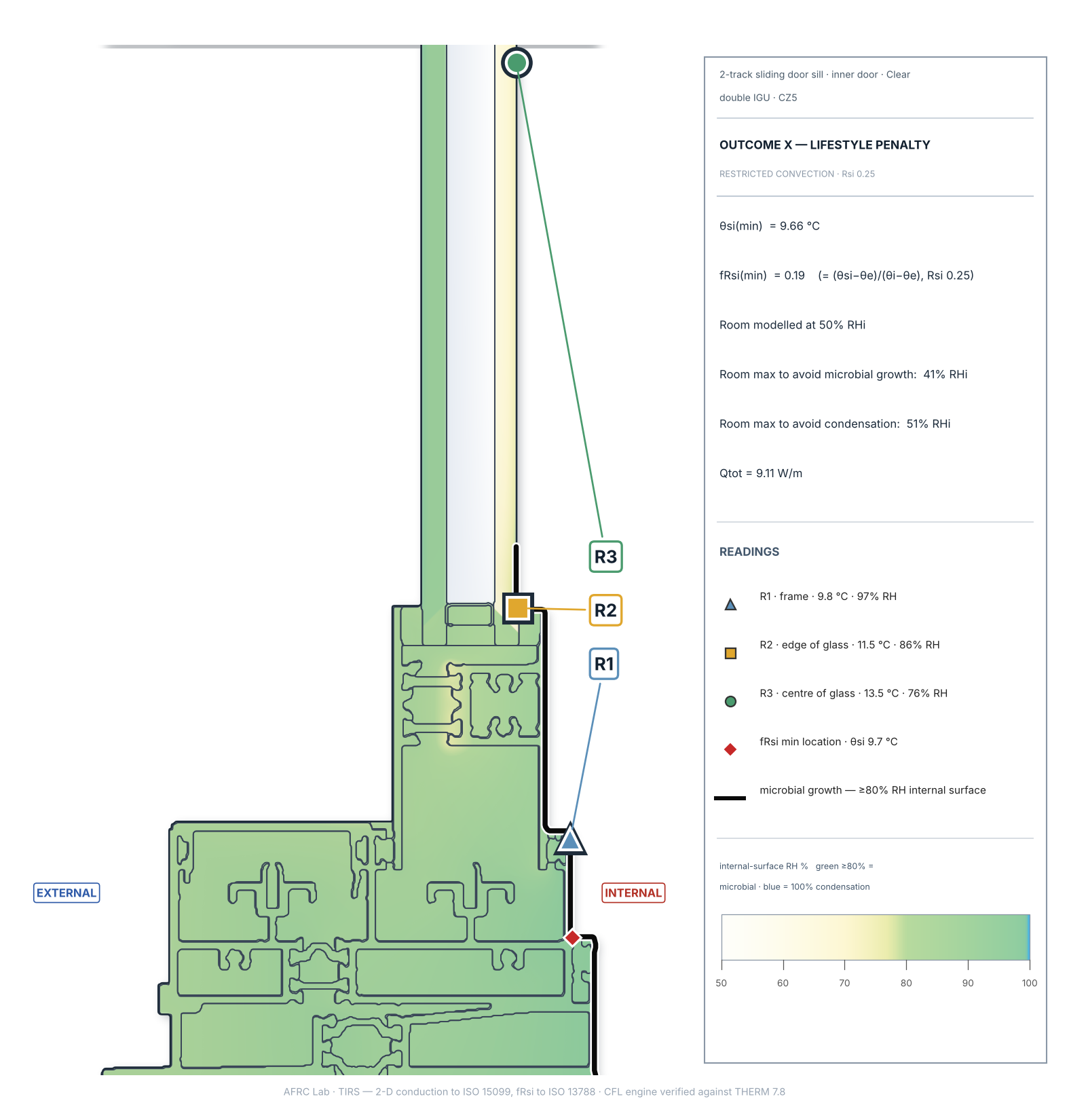
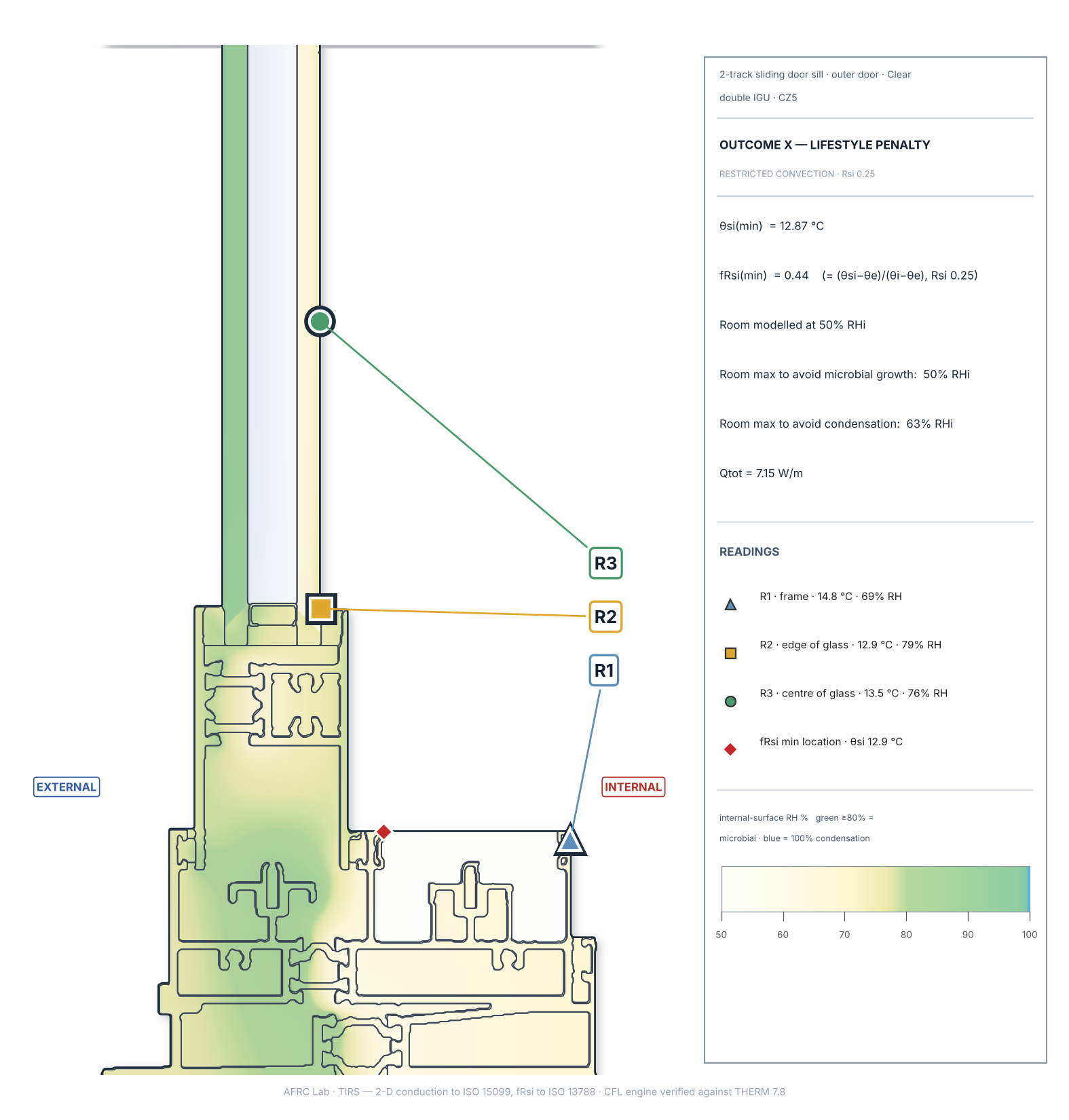
TIRS Outcome X, climate zone 5. Green marks where the inside surface passes 80% humidity (mould territory); the black line is active microbial growth. Same sill — the only difference is which door sits over it.
Now the numbers the two sides return, from the same model:
| Same slider, one sill | Inner doorbreak absent | Outer doorbreak present |
|---|---|---|
| Frame U-value | 5.80 W/m²K | 5.75 W/m²K |
| Coldest inside surface (CZ5) | 9.7 °C | 12.9 °C |
| Mould risk once the room passes | 41% humidity | 50% humidity |
| Temperature factor, fRsi | 0.19 | 0.44 |
Read the top row first: the frame U-value barely moves — 5.80 against 5.75. On paper the two sides are the same window. But the inner sill runs 3 °C colder at the surface and starts growing mould once the room passes 41% humidity, where the outer sill holds to 50%. Same "thermally broken" label; a world apart on the one surface that actually gets wet.
Why? Because the break is only under one of the two doors — and the heat finds the gap it leaves.
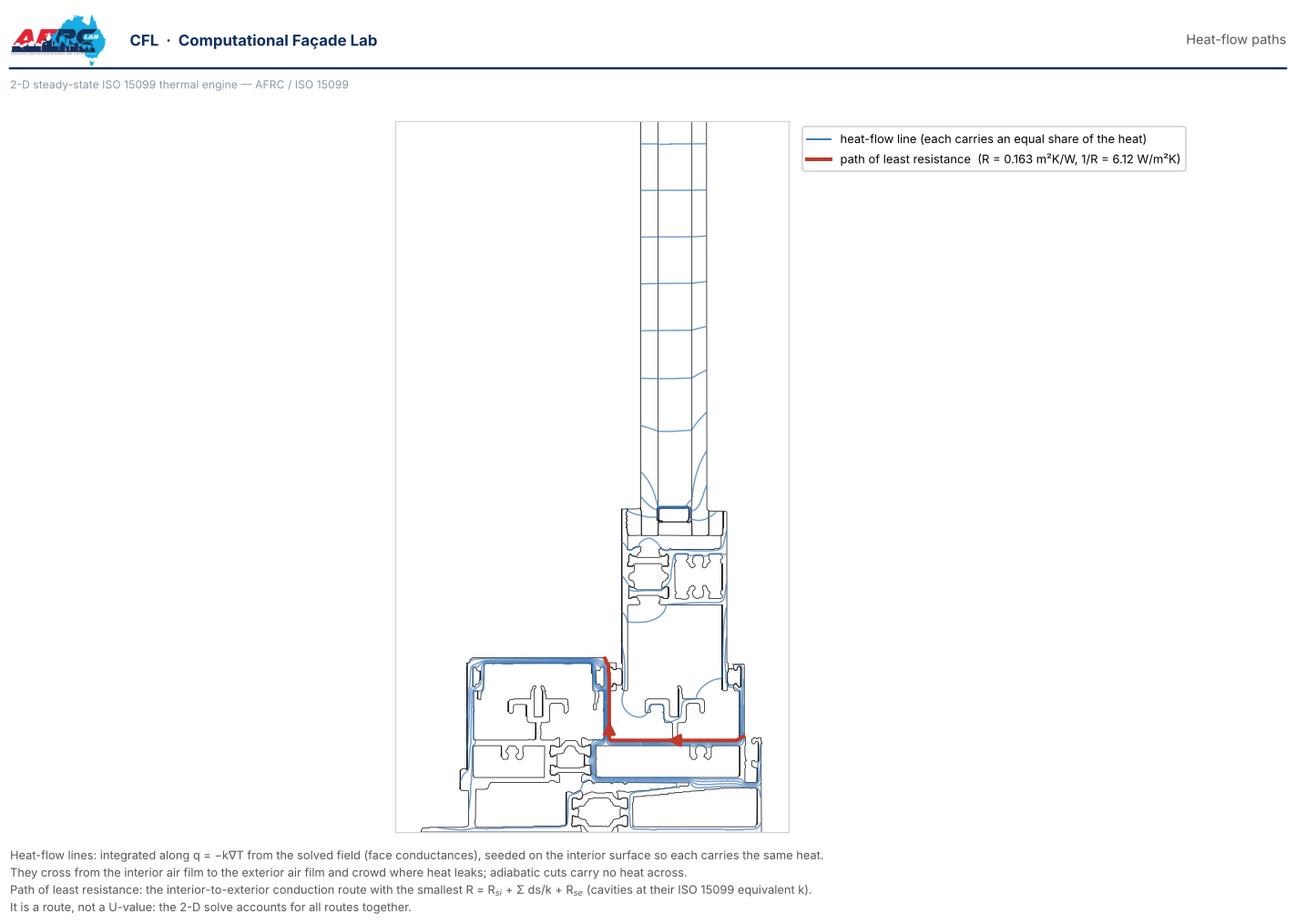
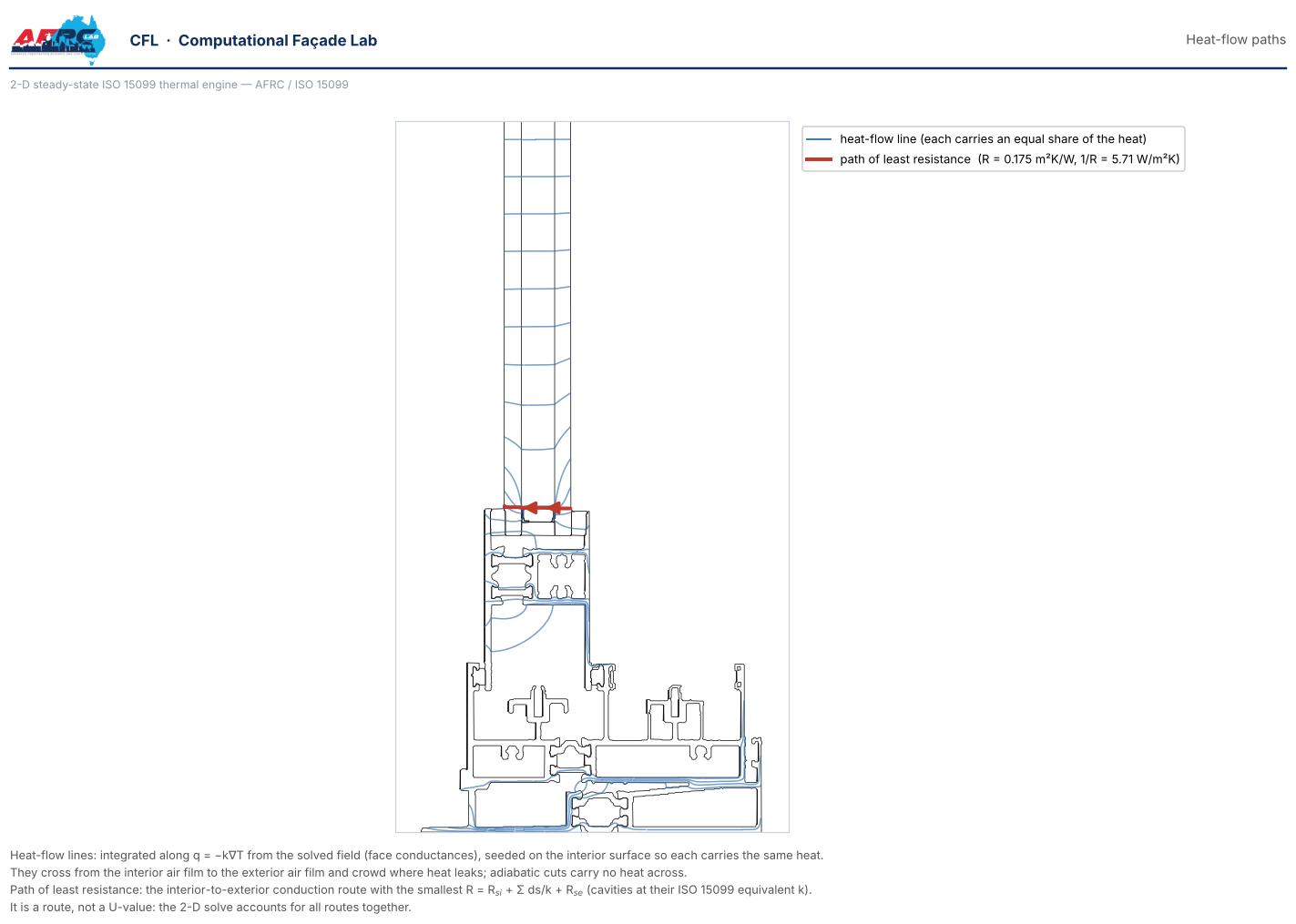
The red line is the route of least resistance for heat leaving the room. Under the inner door there's no break to stop it crossing the sill; under the outer door there is.
Two honest caveats, and both cut the same way — toward worse, not better. Each sill here is a 2-D section modelled on its own; in the real door the two sills are one continuous aluminium extrusion, and aluminium conducts, so the cold under the unbroken inner door bleeds sideways into the "good" outer side too. The clean split is the generous reading, not the worst case. And the model carries no drainage slots: cut those into an uninsulated cavity — as most sliders have — and outside air reaches the internal skins directly, dragging the whole sill back toward a plain aluminium one. That second failure is big enough to earn its own episode; it's the next one in the series.
That's the entire episode in one window: a genuine thermal break, a respectable average U-value, and a sill that grows mould at ordinary household humidity — because the break stops one door short, and the number it gets folded into never shows it.
Model the frame that's built, not the label
The fix is the same move we make everywhere: stop trusting the catalogue claim and model the real thing. Take the actual frame — the break where it genuinely sits, the sill, the interlock and the meeting stile — and resolve it in two dimensions, so you get the true frame U-value and the surface temperature on the coldest line, not a brochure figure. That's where a residual bridge shows up as what it is, and where you can see whether the coldest metre stays above the dew point. Taken to the junction, that's the Mould Index at the surface that actually governs.
"Thermally broken" is worth paying for. It's just not a substitute for knowing where your frame is still cold — and on most frames, somewhere, it still is.
Find out if "broken" means broken.
Send us one thermally broken window or door. We'll model the real frame in 2D — the break, the sill, the interlock and the meeting stile — and show you the true frame U-value and the surface temperature on its coldest line, so you can see whether the bridge is actually gone or just relocated. The first one costs you nothing.
Start with one window →Common questions
A thermally broken slider grows mould on one side of the sill but not the other — how?
Because the break often stops one door short. We modelled one slider's sill under both doors: the frame U-value barely moved — 5.80 against 5.75 W/m²K — but the sill under the unbroken inner door ran about 3 °C colder at the surface and started growing mould once the room passed 41% humidity, where the broken outer side held to 50%. The area-weighted average looks the same on both sides; the one cold surface that actually condenses does not.
Does a thermally broken window remove the thermal bridge?
Not necessarily. A thermal break interrupts the main metal path through the frame, which is a real improvement — but the bridge can survive through the sill or threshold, an incomplete break where only one track or sash is broken, the interlocks and meeting stiles, or metal hardware such as rollers and fixings. "Thermally broken" describes a component, not the coldest line of the installed frame.
Can a thermally broken sliding door still get cold or condense?
Yes. On sliders the residual cold paths are usually the meeting stile or interlock (where interior aluminium sits close to the cold outer extrusion), the bottom track and its drainage channel, an incomplete break that leaves one sash as solid aluminium, and steel roller hardware that links the sash to the outer sill. Any of these can run below the dew point even on a "thermally broken" system.
Why doesn't the window U-value show the residual bridge?
Because the frame's conductivity is area-weighted into the whole-window U-value (Uw), and that figure is often averaged again across a project or system. The residual bridge on one part of the frame is smoothed into a single respectable-looking number, so the coldest line — where condensation forms — doesn't appear as a bridge.
Illustrative mechanisms. The residual-bridge paths described (incomplete breaks, sills and thresholds, interlocks and meeting stiles, hardware, break position) are common mechanisms by which a thermally broken frame can retain a cold line; whether and where any occurs depends on the specific system and installation. "Thermally broken" frames are a genuine performance improvement over plain aluminium. Project-specific thermal simulation to ISO 15099 / NFRC 100, with condensation assessed via the surface temperature and Mould Index (TIRS); modelled results are indicative to the systems and details provided, and final NCC compliance is determined by your assessor or certifier. AFRC Lab (Advanced Fenestration Research & Certification) is an independent company; it is not the AFRC and is not affiliated with WERS. TIRS™ is a trademark of AFRC Lab Pty Ltd (patent pending).