Where windows really grow mould.
We modelled 40 window installation details hour by hour for a full year — the frame, the gap around it and the wall — and scored every surface on the AIRAH DA07 Mould Index used by the NCC verification methods F8V1 and H4V5. The glass was never the problem. The frame, the reveal and the installation gap were.
What we found
Fails in every case
Aluminium without a thermal break reached the maximum mould index (6.0). A thermally broken frame scored 4.3–4.6 in zone 5 and 5.8–5.9 in zone 6 — better, still over the limit of 3.
The tape and fill decide it
Closed-cell tape with an empty gap: 4.7–5.7, fail. Vapour-open tape with the gap filled by pre-compressed foam tape: 0.3–0.8, a clear pass.
Never the issue
The room face of the glass stayed below 0.2 in all 40 cases. Double glazing keeps the glass dry — it doesn’t fix what is around it.
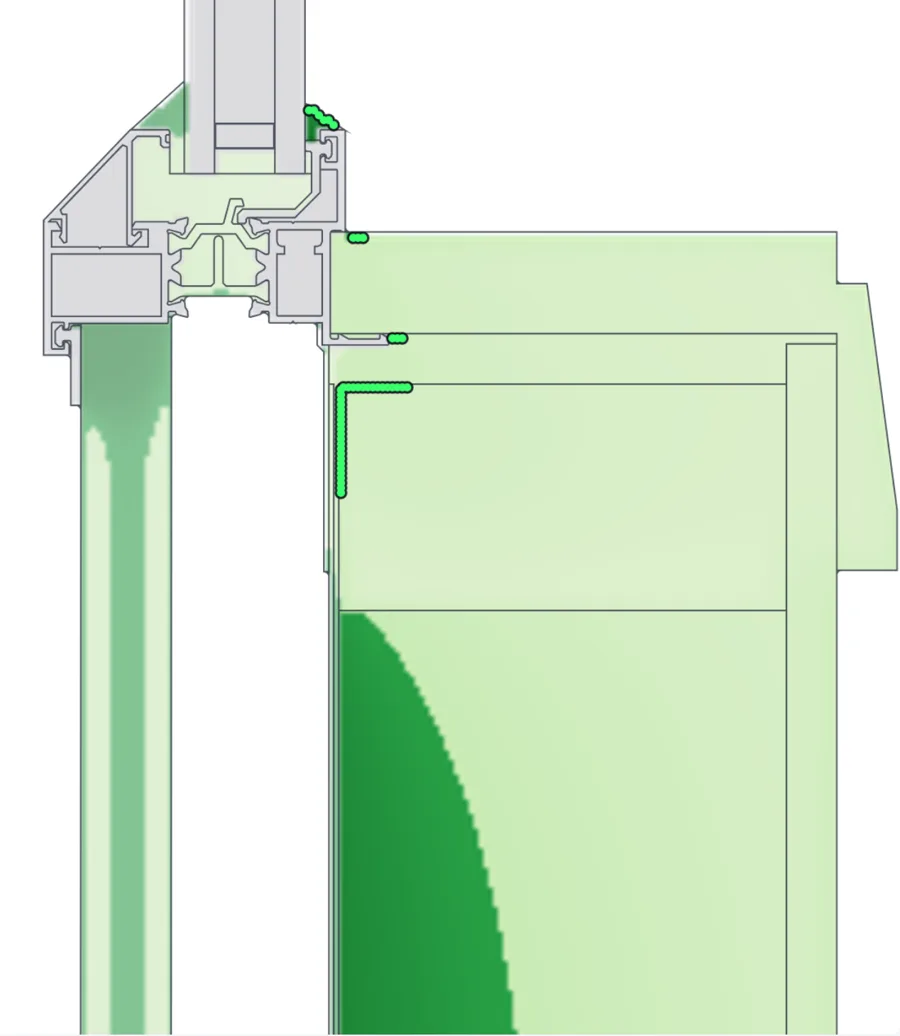
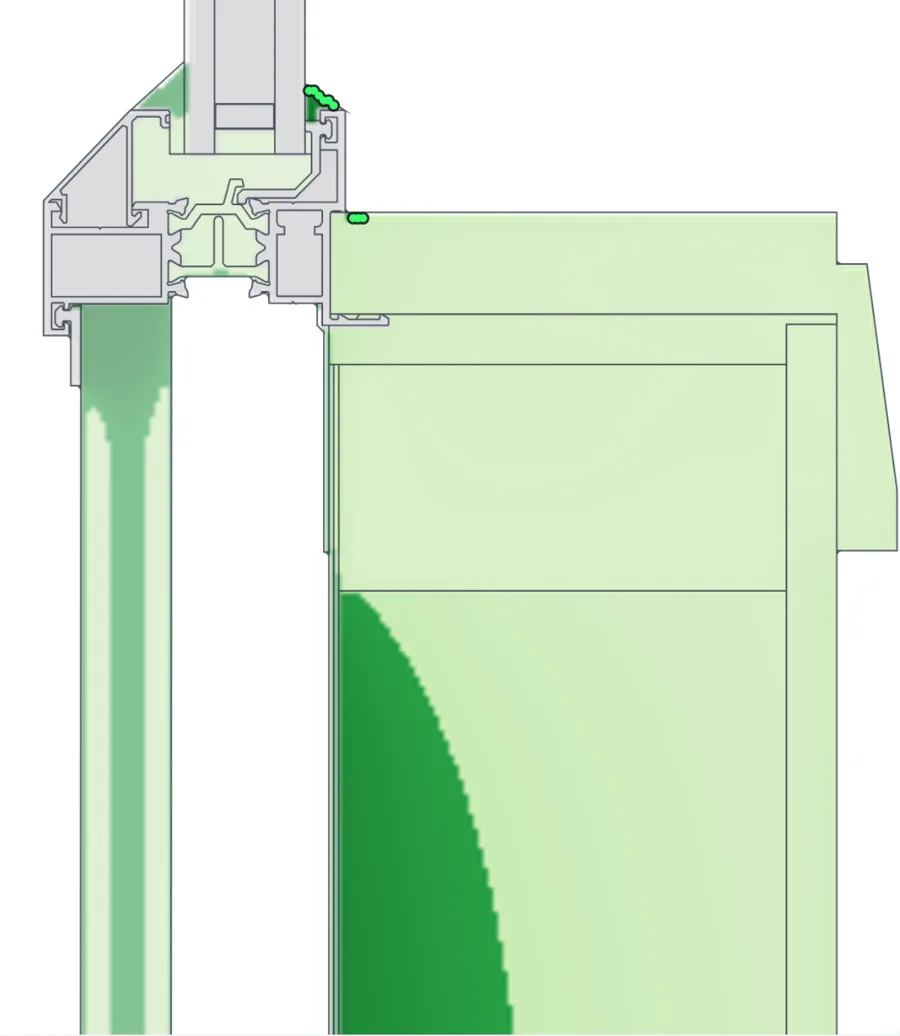
All 20 results, zones 5 and 6
Double glazing with triple-silver low-e and a warm-edge spacer. Peak DA07 Mould Index over the year for each zone of the junction. Below 3 passes. We flag 2.5–3 as marginal so it isn’t mistaken for comfortable headroom.
| Window frame | Gap seal & fill | Zone 5 (e.g. Sydney) | Zone 6 (e.g. Melbourne) | ||||
|---|---|---|---|---|---|---|---|
| Frame | Gap | Wall | Frame | Gap | Wall | ||
| Aluminium, no thermal break | Closed-cell tape, gap left empty | 5.99 | 5.41 | 2.83 | 6.00 | 5.72 | 2.41 |
| Aluminium, no thermal break | Vapour-open tape, gap left empty | 5.99 | 2.61 | 2.87 | 6.00 | 4.01 | 2.39 |
| Aluminium, no thermal break | Vapour-open tape + narrow pre-compressed foam tape | 5.99 | 1.44 | 2.37 | 6.00 | 2.03 | 1.58 |
| Aluminium, no thermal break | Vapour-open tape + pre-compressed foam tape filling the gap | 5.99 | 0.68 | 2.45 | 6.00 | 0.26 | 1.74 |
| Aluminium, no thermal break | Closed-cell tape + PU spray foam | 5.99 | 3.09 | 2.41 | 6.00 | 4.17 | 1.69 |
| Aluminium, thermally broken | Closed-cell tape, gap left empty | 4.40 | 4.68 | 2.98 | 5.81 | 5.51 | 2.64 |
| Aluminium, thermally broken | Vapour-open tape, gap left empty | 4.55 | 1.32 | 3.01 | 5.87 | 1.79 | 2.61 |
| Aluminium, thermally broken | Vapour-open tape + narrow pre-compressed foam tape | 4.41 | 1.47 | 2.37 | 5.81 | 2.01 | 1.59 |
| Aluminium, thermally broken | Vapour-open tape + pre-compressed foam tape filling the gap | 4.43 | 0.75 | 2.45 | 5.82 | 0.26 | 1.74 |
| Aluminium, thermally broken | Closed-cell tape + PU spray foam | 4.28 | 2.94 | 2.41 | 5.75 | 3.42 | 1.69 |
Results with double-silver low-e glass on an aluminium spacer (the other 20 cases) are in the interactive study; the gap and wall results match these closely, because the glass doesn’t reach those zones.
What it means for architects, builders and window makers
Specify the interface, not just the window
A window’s U-value and glass tell you nothing about the reveal. The detail where the frame meets the wall — tape type, gap fill, frame position — is where mould risk is won or lost.
Closed-cell tape and an empty gap is the worst combination
It traps vapour on the room side and leaves a cold cavity. A vapour-open tape with the gap filled gave the lowest gap result in every case we modelled.
The frame still has to be warm enough
Even the best installation did not rescue a cold frame edge in zones 5 and 6. A thermal break helps; proving the frame and reveal pass needs the real system modelled.
How the study was done
- Model: two-dimensional heat, air and moisture (HAM) simulation of the sill-to-wall junction, hour by hour for a full year from 1 January, on a 1 mm moisture grid.
- Wall: lightweight timber-framed wall — loose wall wrap with a 1 mm air layer behind it, insulated studs, plasterboard lining and a timber reveal.
- Cases: 2 aluminium frames (no thermal break, thermally broken) × 5 gap seal and fill details × 2 glass types × climate zones 5 and 6 = 40 runs.
- Climate: the worst (cold design) year of hourly weather for each zone; south-facing wall (least sun); room conditions to the AIRAH DA07 intermediate method with ventilation and air conditioning.
- Assessment: AIRAH DA07 Mould Index (VTT model) on every room-side surface and every material interface on the room side of the water control layer, grouped into frame & reveal, gap and wall.
- Verification: the moisture solver reproduces the EN 15026 Annex B verification case (48 of 48 points) and the HAMSTAD 1, 2 and 5 benchmarks, including a five-year match to COMSOL on HAMSTAD 1. On every section the heat solver reproduces the steady-state result of AFRC Lab’s THERM-validated 2-D thermal engine.
Concept study of generic details. Material properties for tapes, foams and sealants are generic unless tested data are supplied. A full compliance assessment uses ten consecutive weather years and the project’s real system and wall build-up.
Questions people ask
Why is there mould on my window frames and reveals?
The frame and reveal are the coldest room-side surfaces. With ordinary indoor humidity their surface relative humidity sits above 80 % for long periods in winter, which is what drives mould growth. An aluminium frame without a thermal break reached the maximum mould index in every case we ran; a thermally broken frame was better but still failed in zones 5 and 6.
Does double glazing stop condensation on windows?
It keeps the glass dry — the room face of the glass stayed below a mould index of 0.2 in all 40 cases — but it does not fix the frame, the reveal or the gap around the window. That is where the risk sits.
Does the tape and gap fill around a window matter for mould?
Yes. With closed-cell tape and an empty gap the gap reached 4.7–5.7 (fail). Vapour-open tape with the gap filled by pre-compressed foam tape brought it to 0.3–0.8 (pass). The frame itself still needs to be warm enough to pass.
What does the NCC require for condensation and mould?
NCC Volume One F8 and Volume Two H4 cover condensation and water vapour management. The verification methods F8V1 and H4V5 use hygrothermal modelling to the AIRAH DA07 method; a mould index below 3 is the pass mark used here.
Is this a compliance certificate for my project?
No — it is a concept study of generic details. Every window system and wall build-up is different. Send us yours and we’ll assess the real detail.
See it move, day by day.
The interactive study lets you build the junction — frame, tape, gap fill, glass and climate — and watch heat, humidity and mould develop through the year. It is shared with partners and project teams; ask us for access.
Request accessI have a password